

The Jersey Devil: Legend, Lore, Hoax

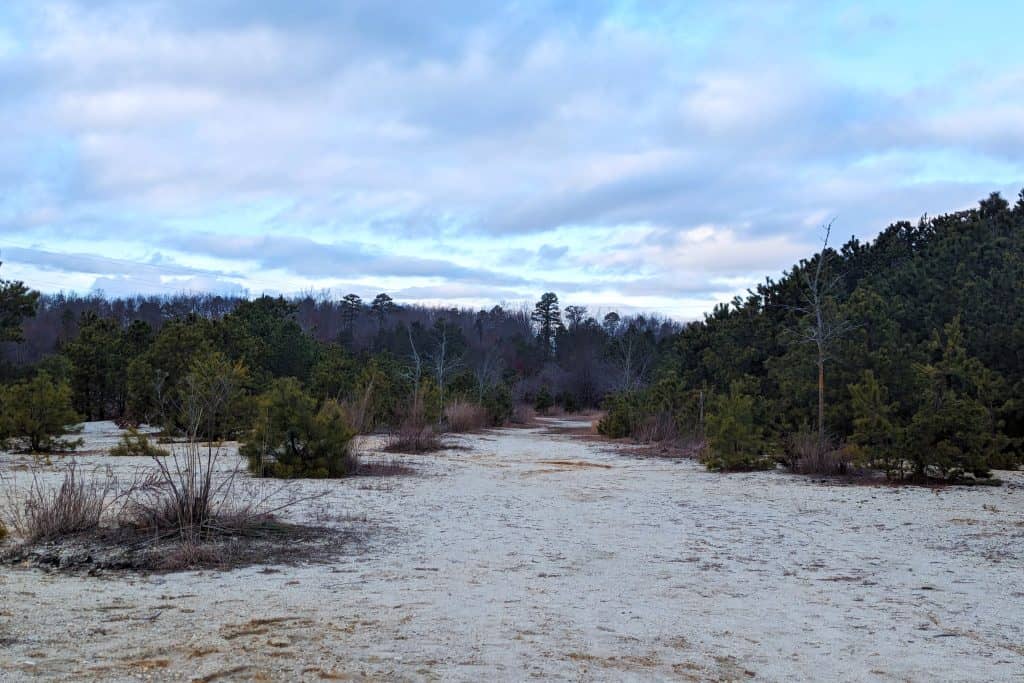
Let me take you to a place where dense pine and oak forests grow from sandy, nutrient-poor, acidic soil. Their twisted roots reach below the surface to an unseen force that shapes the landscape; the vast Kirkwood-Cohansey Aquifer. Holding over 17 trillion gallons of some of the country’s purest water, the groundwater seeps into cedar streams, the color of tea, whose currents flow silently through stands of Pygmy Forests, before slipping away toward the bay.

Alongside waterways are Atlantic White Cedar swamps where once-thriving farming and industry have left ghost forests. An impenetrable tree canopy makes these blackwater swamps dark on the sunniest days. In the still of these sunless places, time feels suspended—a perfect backdrop for the legends whispered through the woods, where something seems to linger in the shadows.

Unsurprisingly, a place as weird and eerie as the New Jersey Pine Barrens is the backdrop for many creepy tales. But none have captivated the imagination of so many or persisted as long as the Jersey Devil.
The Origin of the Jersey Devil
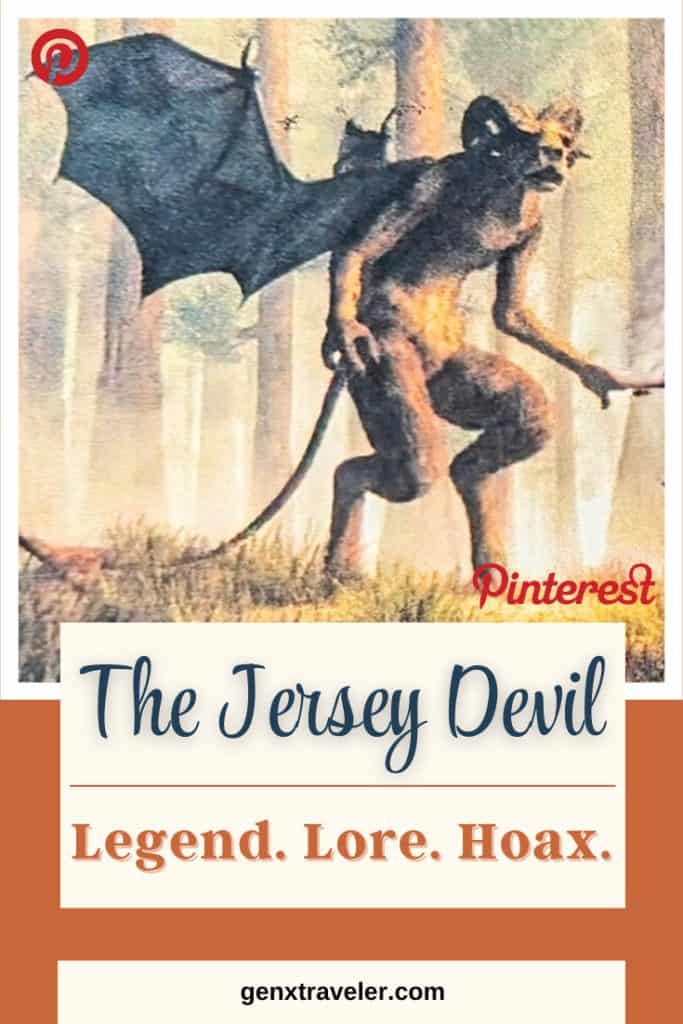
Described as a kangaroo-like creature with the head of a horse, bat-like wings, horns, and a tail, the Jersey Devil is believed to have roamed the Pine Barrens and swamps of Southern New Jersey for more than 250 years occasionally making appearances in cities and towns as far away as Maryland.
Like most creepy tales shared over decades, there is more than one origin story for the Leeds Devil. Though details change, there is some overlap among the tales.

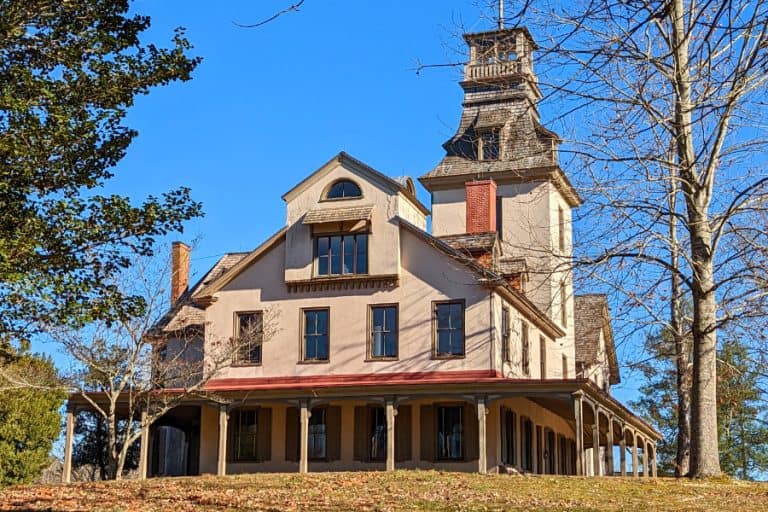
Some areas of overlap are the Leeds Devil or Devil of Leeds, as it was called before the 1900s, was either born to Mrs. Shrouds at the Leeds House in Leeds Point or Mother Leeds in Estellville.
According to the Leeds Point account, Mrs. Shrouds made a wish that if she ever had another child, she wanted it to be a devil. When her next child was born it was deformed. She kept the child hidden from the public until one stormy night, the child flapped its arms which became wings, and it flew up the chimney, never to be seen again by the family.
The Estellville story claims that when Mother Leeds learned she was pregnant with her thirteenth child she shouted, “I hope it’s a devil.” When the child was born it had horns, a tail, wings, and a horse-like head, a similar description to a Kangaroo creature.
Yet another story ties the birth of the Jersey Devil to Leeds Point. This version claims a young girl fell in love with a British soldier during the Revolutionary War. The people of Leeds Point cursed her. When she gave birth, she had a devil. Some people believe the birth of the devil/child was punishment for the mistreatment of a minister by the Leeds folk.
Go searching for the Jersey Devil in New Jerseys Pine Barrens using our 3-Day Itinerary.
The History Behind the Legend
As with most legends and lore, there is verifiable history surrounding the Jersey Devil. While no one knows for sure the origins of the story, it seems the tale has evolved and has roots within the Leeds family who were prominent in and around Leeds Point in the early 1700s.
According to historical records, Daniel Leeds immigrated to Burlington County, NJ in the late 1600s becoming NJ’s first surveyor and a prominent pre-Revolutionary New Jerseyan.

Adding to the legend, Daniel, calling himself a “Student of Agriculture,” authored books and Almanacs that contained astrological symbols and writings. His almanacs were forbidden in the Quaker faith and created a scandal on both sides of the Atlantic.
Furthermore, “colonial-era political intrigue” between Leeds and the publisher of the Poor Richard’s Almanac, rival, Benjamin Franklin led to Leeds being described as the “Leeds Devil” and his family called, “monsters.” Some believe this evolved into the legend of the Jersey Devil.
It is thought that Deborah Smith who married Daniel’s son Japhet in 1704 may be Mother Leeds. Genealogical records show that Japhet and his wife Deborah had 12 children, with Hannah their 12th, born in 1726. It’s been theorized that the couple’s 13th child was born deformed and kept hidden, which wouldn’t have been unheard of for the time.

Deepening the connection between the Leeds family and the Jersey Devil, Titan Leeds, who inherited the almanac business, after his father’s death in 1720, began using the family crest on the book’s cover. The charge depicts a wyvern, a bat-winged dragon-like creature that stands upright on two clawed feet similar to the popular description of the Leeds Devil.
Early Sightings of the Leeds Devil
Throughout the 18th and 19th centuries, there were some isolated sightings of the Leeds Devil in and around the Pine Barrens.
One seemingly credible report came in the early 19th century when Naval Commander, Stephen Decatur saw the creature while testing cannon balls at Hanover Mills Works in the Pine Barrens. It was reported that the commander shot a cannonball at the beast blowing a hole through it, yet the Devil was unfazed.
Another sighting involved Napolean Bonaparte’s brother, Joseph Bonaparte who claimed to have seen the Jersey Devil while hunting on his Bordentown estate around 1820.
Two decades later, the Jersey Devil was blamed for several livestock killings.
While these were mostly isolated occurrences, in 1909 that all changed. At that time there was a flurry of claimed encounters.
From January 16–23, 1909, newspapers reported sightings all over South Jersey and the Philadelphia region. Nearly 1,000 encounters were reported during that time.
Unidentified footprints in the snow quickly led to reports of creatures resembling the Jersey Devil across South Jersey and even as far as Delaware and western Maryland. Widespread newspaper coverage fueled fear throughout the Delaware Valley, leading to school closures and workers staying home.
Since then, there have been additional isolated reports of Jersey Devil sightings. But nothing so robust as those of the early 20th century.
Was it all a Hoax?
In the early 20th century, the Jersey Devil shifted from folklore to legend, cementing its place in New Jersey’s cultural fabric. Although isolated encounters with the beast had been whispered about for years, it wasn’t until the 1909 sightings that the creature’s image—bat-like wings, a horse’s head, claws, and a dragon-like aura—became widely recognized.
Enter T.F. Hopkins, Philadelphia’s Arch Street Museum’s proprietor, and Norman Jeffries, a savvy publicist and man known for his flair for hoaxes. Faced with the potential closure of the museum, the pair saw the Jersey Devil as the perfect solution to the museum’s attendance problem. Together they concocted a plan to bring the legend to life.

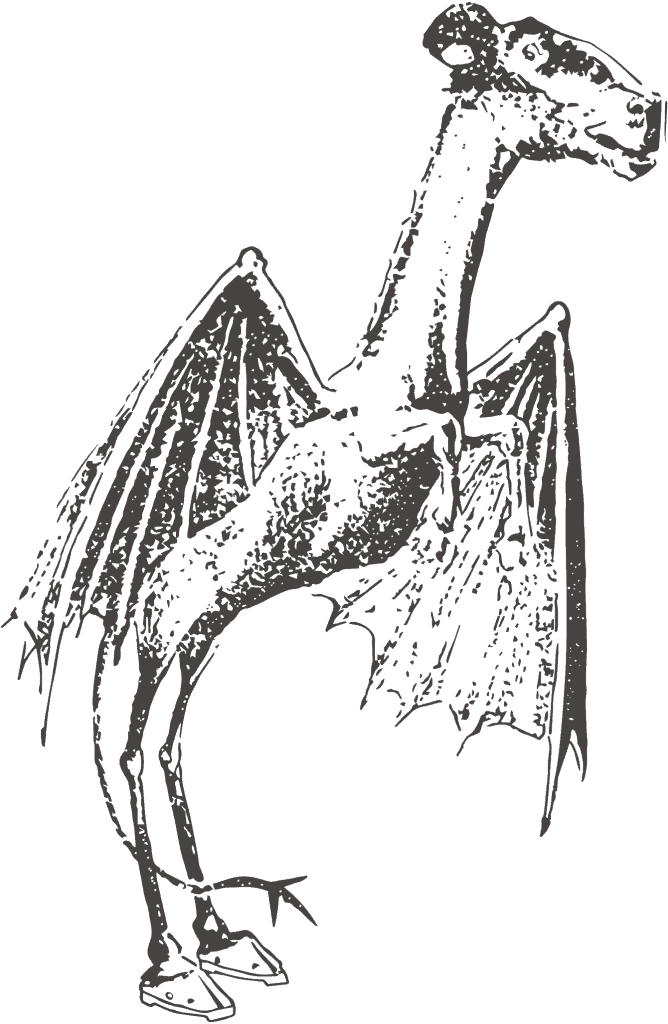
Jeffries began by planting sensational newspaper stories about recent Jersey Devil sightings stirring public interest and fear. Then, in a bold move, he and animal trainer Jacob Hope acquired a kangaroo from a circus. Attaching fake claws and bat wings to the animal, they proclaimed they had captured the Jersey Devil and displayed it at the museum. With sensational claims of “Caught!!! And here!!! Alive!!! The Leeds Devil. Swims! Flys! Gallops! … the spectacle drew crowds, as planned.
Jeffries later admitted the entire stunt was a hoax, yet it successfully cemented the Jersey Devil’s place atop the Garden State’s legends. This elaborate ruse, combined with the widespread hysteria of the time, ensured that the Jersey Devil would remain a lasting and eerie figure in New Jersey’s folklore.
More Recent Jersey Devil Sightings
Despite Jeffries’s admission that it was all an elaborate scheme, since the infamous wave of sightings in 1909, there have been scattered accounts of encounters with the creature. Here are a few.
1927 – Salem City, NJ
One of the most notable post-1909 sightings occurred in 1927, when a taxi driver in Salem City, New Jersey, claimed he was changing a flat tire late at night when he heard strange, shrill screams from the woods. Suddenly, the Jersey Devil appeared, flying toward him before vanishing into the darkness. Shaken by the encounter, the man later reported the sighting, describing the creature’s bat-like wings and horse-like head.
1960 – Mays Landing, NJ
In 1960, the town of Mays Landing was gripped by fear after several residents reported hearing terrifying screams echoing through the night. With no explanation for the eerie noises, panic began to spread. Attempting to calm the growing unrest, local police distributed flyers, insisting the Jersey Devil was nothing more than a myth.
However, a circus owner saw an opportunity and offered a $100,000 reward to anyone who could capture the elusive creature. Despite the incentive, no one ever claimed the prize.

1972 – Green Tree Road, NJ
In 1972, while driving down Green Tree Road near Woodstown Mary Ritzer Christianson claims she spotted the Jersey Devil crossing the road while looking in her rearview mirror. She described the creature as having large leathery wings, a woolly body, and a horse’s head but stood upright like a human. This sighting reignited interest in the legend during the early 1970s.
Sightings in the 1980s
At a South Jersey Farm Near Wharton State Forest
In 1980, Wharton State Forest Chief Ranger Alan MacFarlane encountered a disturbing and baffling scene at a South Jersey farm. A pack of pigs had been brutally slaughtered, with the backs of their heads eaten and their bodies scratched, yet there were no tracks or blood around the site. MacFarlane had never seen anything like it, leaving locals to speculate that the Jersey Devil may have been responsible. The mystery of the attack remains unsolved.
Near a Campground in The Pine Barrens
In the late 1980s, a group of friends went camping and dirt bike riding in the Pine Barrens. About 100 yards from camp, their bikes suddenly stalled. While they tried to figure out the problem an unearthly scream echoed from the woods.
When they returned, those who had stayed at the camp said they had heard the same chilling sound. That evening, one of the men mentioned the incident to a bartender at a local bar, who casually told him they had likely encountered the Jersey Devil, a common occurrence in those woods.
1993 – Mullica River, NJ
In 1993, Forest Ranger John Irwin, a seasoned outdoorsman encountered a mysterious creature while driving along the Mullica River in the New Jersey Pine Barrens. Standing over six feet tall, with thick, matted black fur and horns, the creature blocked his path. Irwin and the beast locked eyes for several tense minutes before it retreated into the forest.
Though some suggest it could have been a black bear, Irwin, an experienced ranger, insisted it was unlike anything he’d seen before. With no way to capture evidence, the sighting remains unexplained.
2015 – Galloway Township, NJ
One of the more recent sightings occurred in 2015 in Galloway Township, when David Black a resident took a picture of what he believed was the Jersey Devil standing inside a fenced area along the roadside. As he reached for his camera, the creature unfurled enormous wings and took flight, vanishing before his eyes.
The image quickly spread online, sparking debate about its authenticity. The photo showed a creature with large wings and hooves, eerily resembling the traditional description of the Jersey Devil.

Bayville, NJ – Year Unknown
While driving on Route 9 in Bayville one evening, three cars were forced to slam on their brakes when a towering, ten-foot-tall creature with a long head and short ears darted across the road. Emerging from the woods near a mini-mall, the figure galloped in front of traffic before vanishing into the trees on the other side. One witness described it as resembling the classic depictions of the Jersey Devil, insisting it was no ordinary animal, despite others dismissing it as a deer.
Galloway Township, NJ – Year Unknown
One quiet evening, Fran Coppola, owner of the Smithville Inn, stepped outside to dispose of the restaurant’s trash. As she looked up, she froze. Hovering above her was the unmistakable shadow of a winged creature. Strangely, she felt no fear. Instead of running, Fran stood still, transfixed by the sight. At that moment, she believed she was not witnessing an attack, but rather the Jersey Devil acting as a protector, watching over the Inn like an eerie guardian.
Despite the skepticism surrounding such sightings, these encounters continue to add to the Jersey Devil’s legend. Locals still tell stories of strange noises in the night, unidentifiable tracks in the snow, and fleeting glimpses of something strange moving through the trees. Whether real or imagined, the Jersey Devil remains a living part of Pine Barren’s folklore.
Like this Post?? Share it NOW!